Keep learning
Growth leadership
How do you make all four engines work together instead of in isolation?


Clear mental clutter by transferring all thoughts, tasks, and ideas onto paper or screen, creating space for focused work.
.webp)
Does your mind feel like a browser with too many tabs open? Each thought, task, or idea fights for your attention, slowing you down and making it hard to focus. When mental clutter builds up, even small decisions can feel overwhelming.
The solution isn’t to push through or hope things magically clear up it’s to hit the reset button with a brain dump. A brain dump is the process of unloading everything onto paper or into a structured system. A brain dump declutters your mind, helps to regain focus, and creates a clear path forward.
In this chapter, I'll guide you through a step-by-step brain dump process. We’ll start with your objectives and key results (OKRs), move down to your roles, projects, and tasks, and end with a backlog for future ideas. This exercise creates the foundation for a well-organised task management system in later chapters.
Braindumps matter because human working memory is severely limited we can typically hold only 4-7 items at once yet we try to mentally juggle dozens of commitments, ideas, and concerns simultaneously. This constant cognitive load drains mental energy, impairs decision-making, and creates persistent low-level anxiety as your brain repeatedly reminds you of unfinished business. By conducting regular braindumps (weekly or when feeling overwhelmed), you free up cognitive bandwidth for deep, creative work. Research shows that unfinished tasks create intrusive thoughts (the Zeigarnik effect), but simply writing them down reduces this mental interference even before you complete them. For growth marketers managing campaigns across multiple channels whilst responding to stakeholder requests, braindumps prevent important tasks from slipping through the cracks. The technique is particularly valuable before strategic thinking sessions, as it clears mental clutter that would otherwise interrupt your focus. Regular practitioners report reduced stress, improved sleep, and enhanced ability to concentrate on high-value work.
To make your brain dump effective, eliminate interruptions both physical and digital:
You’ll need somewhere to capture your thoughts. A spreadsheet works best because it allows for easy organisation and categorisation later. If you’ve purchased the Master Your Workweek course, use the provided brain dump template (find it below the lesson in the description) for a faster, structured approach.
If you suffer from perfectionism like me, setting a timer for 25 minutes helps. Use this time to unload your thoughts without worrying about organisation or perfection. Once the timer starts, let your ideas flow freely we’ll organise them later.
Start at the highest level by writing down your objectives and their corresponding key results. This ensures your brain dump is aligned with your top priorities.
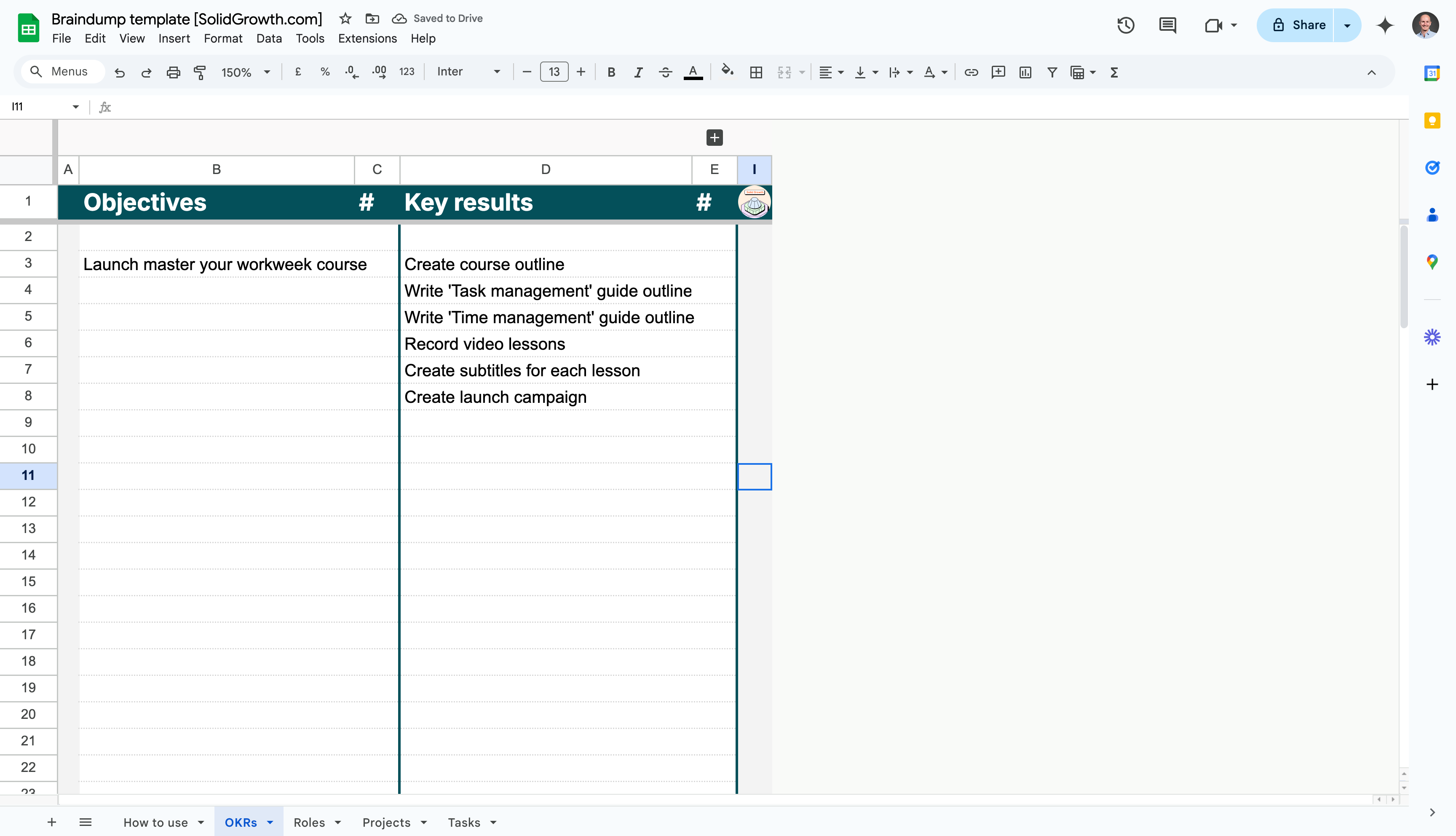
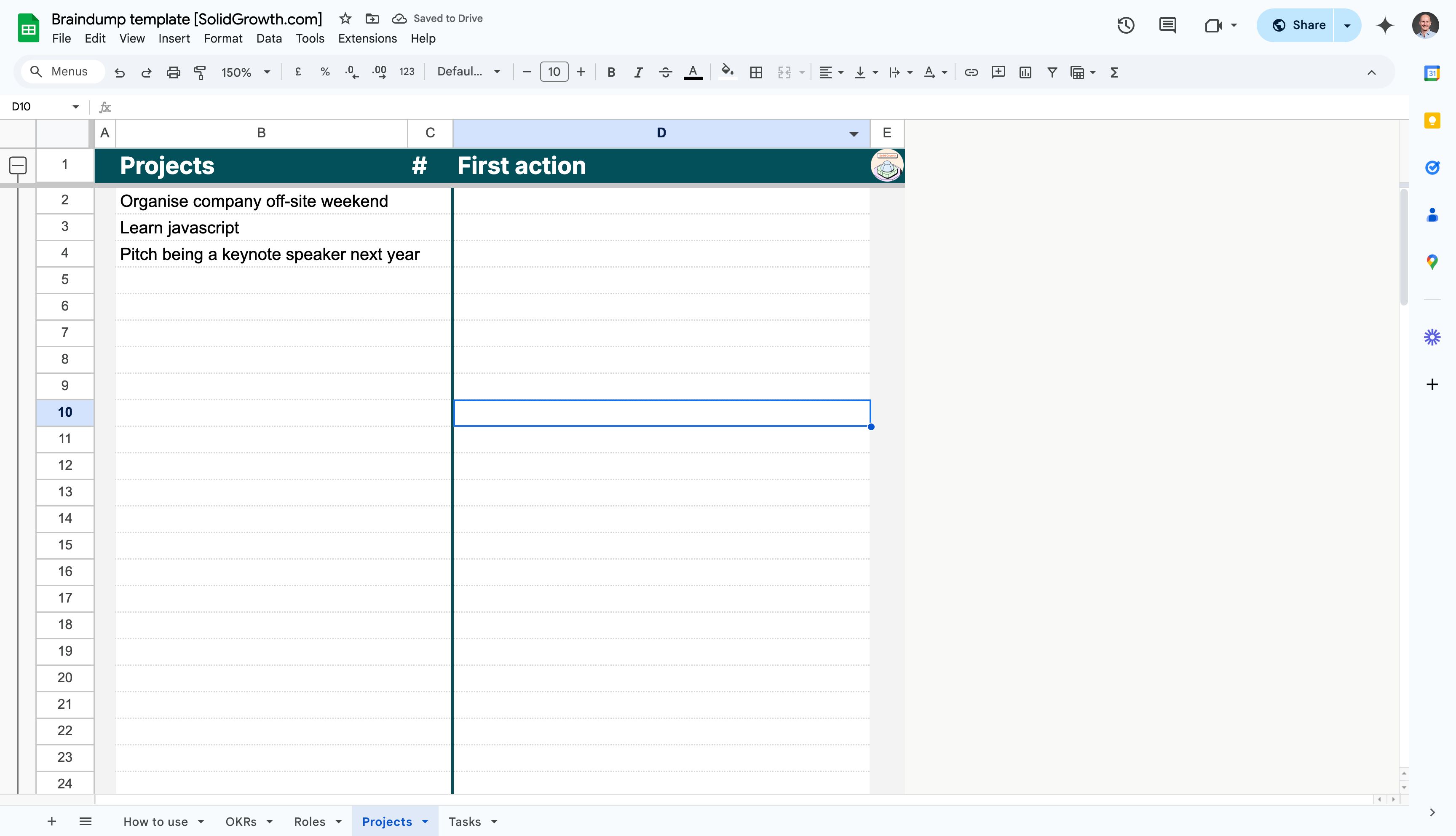
Now, map out the projects that will help you achieve your key results. These are the bigger initiatives or deliverables required to meet your goals.
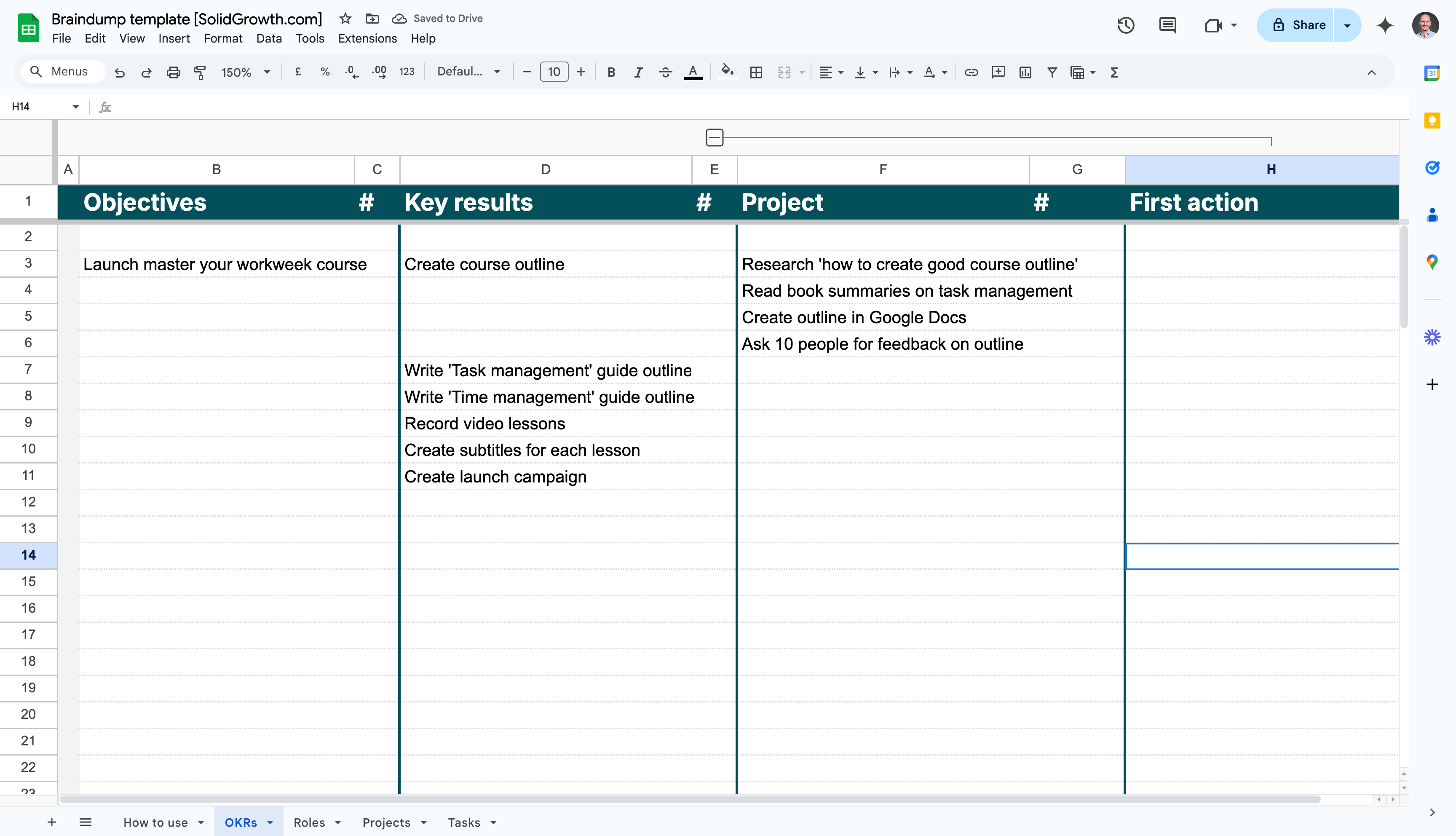
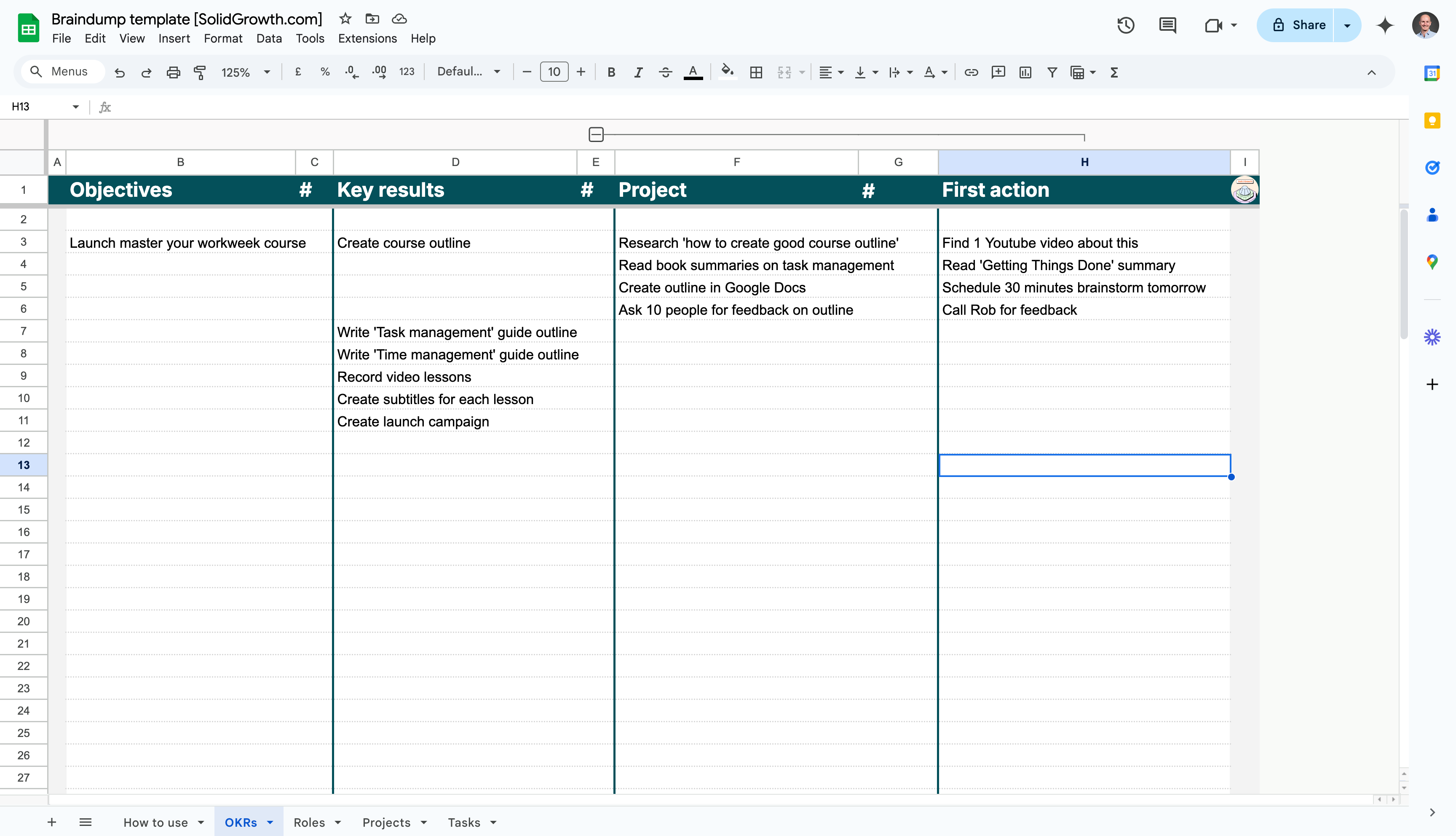
For every project, identify one clear, actionable step you can take to move it forward. This ensures that each project is actionable and not just an idea.
Identify the roles you fulfil in your professional and personal life, along with the recurring responsibilities tied to each role.
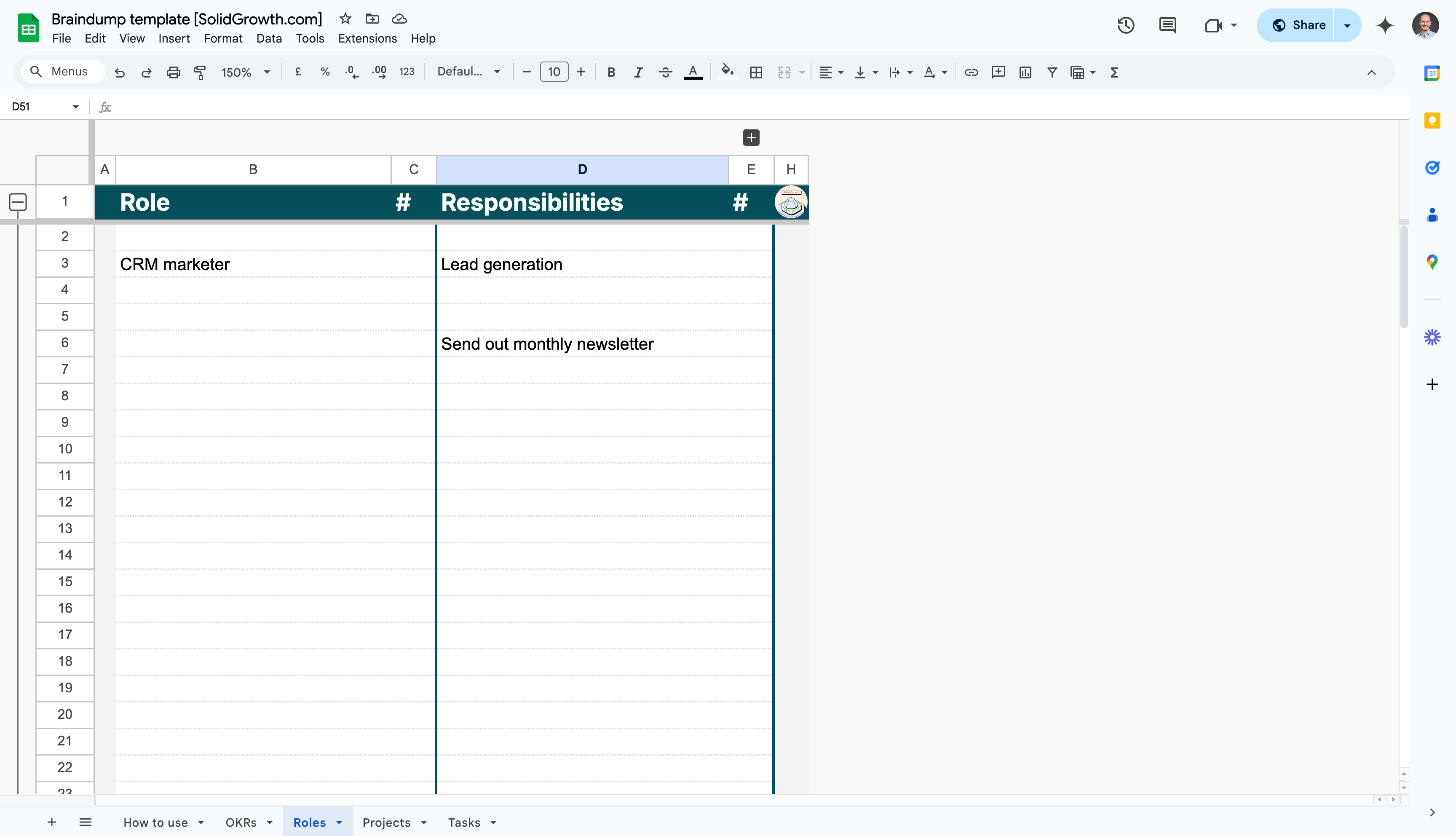
Recurring tasks are the repeatable actions that support your roles and responsibilities. These might include weekly reports, monthly updates, or personal routines.
.png)
Capture any projects that don’t align directly with your OKRs or roles. These might reveal hidden priorities or unnecessary work.
Standalone tasks are one-off actions that don’t belong to a larger project but still need to get done.
.png)
Finally, capture all your long-term ideas, someday/maybe projects, or creative thoughts in the tasks list.
Congratulations! You’ve created a comprehensive overview of your workload, broken into OKRs, roles, projects, tasks, and a backlog.
Studies show that writing things down has a powerful effect on mental clarity. In the 1960s, psychotherapist Ira Progoff introduced the intensive journaling method as a way to explore thoughts, uncover patterns, and gain personal insight. Later, in the 1980s, psychologist James Pennebaker discovered that expressive writing - which he called writing therapy - could reduce stress and improve mental and physical health. The act of putting thoughts on paper isn’t just therapeutic it’s transformative.
Then came David Allen in the early 2000s with his book Getting Things Done. He introduced the “Mind Sweep” as the first step in his productivity system. The idea is simple: your brain isn’t built to store endless lists of tasks, worries, and ideas. It’s built to process information. When you externalise what’s in your head, you free up mental space to think clearly and take action. This system made the concept mainstream, especially for professionals juggling overwhelming workloads.
But we’re in a digital age now. Tiago Forte took things further with his Building a Second Brain framework. He focuses on using digital tools to create an external system for storing and organising thoughts, tasks, and ideas. The principle, though, remains the same: get everything out of your head. Once it’s out, you can see the big picture, prioritise, and act with intention.
At its core, the brain dump is the first step. It’s about clearing the mental clutter so you can organise and make sense of it all. Whether you prefer paper or digital tools, the goal is always the same: free your mind, gain clarity, and create space for what truly matters.
How do you make all four engines work together instead of in isolation?

Build the dashboards and data pipelines that show your growth engines in one view so you can spot bottlenecks and make decisions in minutes, not meetings.

The wrong tools create friction. The right ones multiply your output without adding complexity. These are the tools I recommend for growth teams that move fast.
Analyse last cycle's results across all twelve metrics, identify the highest-leverage improvements, and set priorities that compound into the next period.
Pressure-test your strategy against market shifts, performance data, and team capacity so your direction stays relevant and ambitious.
David Allen
Rating


Rating
Rating
Rating
Rating

Capture, clarify and review without friction. Keep projects moving with weekly reviews and clear next actions.
Tiago Forte
Rating
Rating
Rating
Rating
Rating

How to store research, briefs and ideas so you can reuse them later. A calm framework for notes that supports experiments and content.
Your system for tracking work determines how your team operates. The right tool makes priorities visible and keeps everyone moving without endless status updates.
Most stress comes from not knowing what to work on next. A system where every task has a home, every project has a next action, and you always know what matters.
Measure the percentage of customers who stop paying to identify retention problems and calculate the true cost of growth in subscription businesses.
Systematically rank projects and opportunities using objective frameworks, ensuring scarce resources flow to highest-impact work.
Identify and leverage limitations as forcing functions that drive creative problem-solving and strategic focus.
Drive acquisition and expansion through product experience where users discover value before sales conversations and upgrade based on usage.
Define events that start automation workflows so the right message reaches people at the right moment based on their actual behaviour not arbitrary timing.
Assign credit to marketing touchpoints that influence conversions to understand which channels work together and deserve budget in multi-touch journeys.
Analyse profit per customer to determine if your business model works at scale before investing heavily in growth and customer acquisition.
Measure the month-over-month growth in qualified leads to predict future revenue and catch pipeline problems before they impact revenue three months later.
Structure experiments around clear predictions to focus efforts on learning rather than random changes and make results easier to interpret afterward.
Unify customer data from every touchpoint to create complete profiles that power personalised experiences across marketing, sales, and product.
Connect triggers to actions across systems so repetitive tasks happen automatically and teams can focus on work that requires judgement instead of admin.
Track revenue growth from existing customers through expansion and contraction to prove your product delivers increasing value over time.
Determine whether experiment results reflect real differences or random chance to avoid making expensive decisions based on noise instead of signal.
Credit the channel that introduced prospects to your brand to measure awareness efforts and understand which top-of-funnel activities start customer journeys.
Store raw data from all business systems in one place to run analyses and build reports that combine information across marketing, sales, and product.
Select metrics that reveal whether you're achieving strategic goals to track progress and identify problems before they become expensive to fix.
Store information in browsers to track user behaviour across visits and enable personalised experiences without requiring login for every interaction.
Track predictable yearly revenue from subscriptions to measure business scale and growth trajectory in B2B SaaS and recurring revenue models.
Turn satisfied customers into active promoters who systematically bring qualified prospects into your pipeline at near-zero acquisition cost.
Connect tools so data flows automatically between systems to eliminate manual entry, keep records current, and enable sophisticated workflows across platforms.